
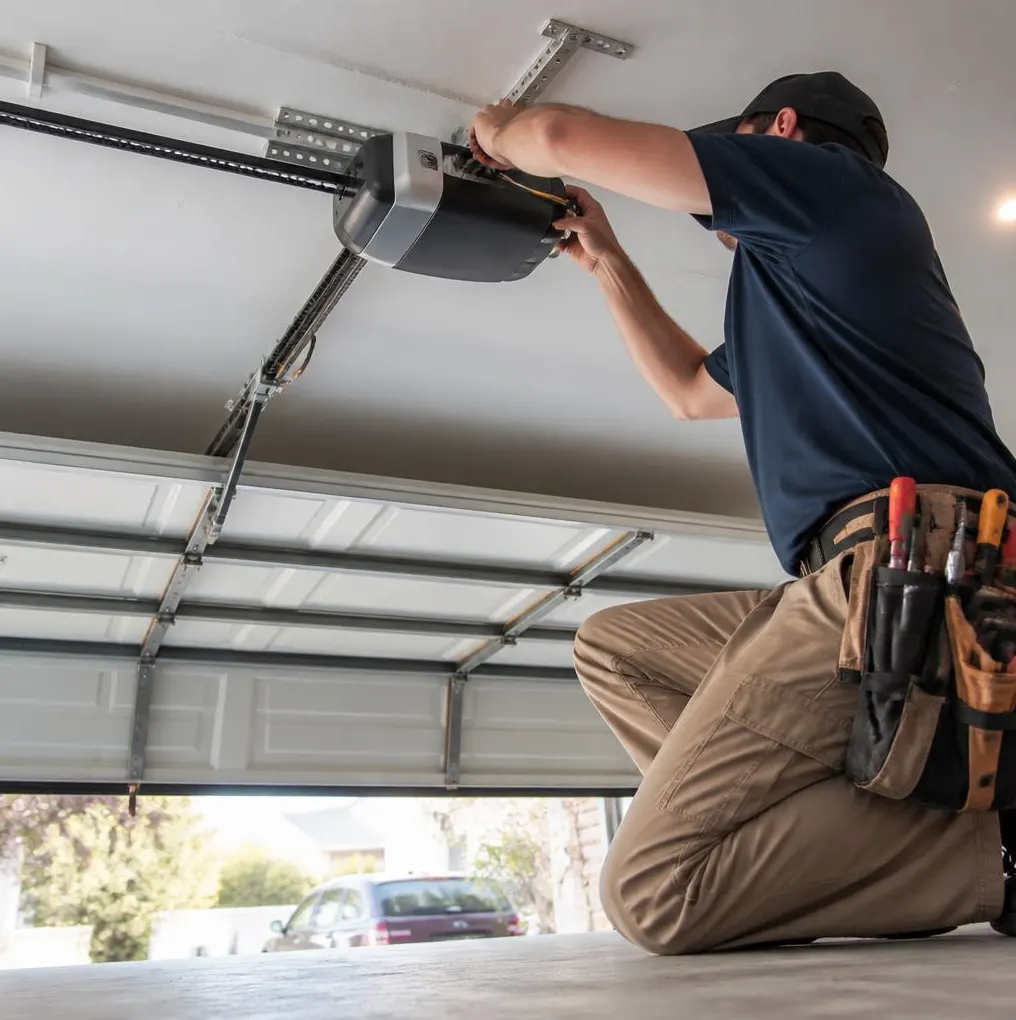
What a Technician Sees After a Windy System Rolls Through
After a few days of strong wind and driving rain, the service calls start sounding the same. A homeowner opens the garage to find the door bowed inward at the center, tracks pulled slightly away from the frame on one side, or panels that look fine but no longer sit flush against the weatherstripping. Sometimes the door still operates, which is almost worse, because the owner assumes nothing happened. In reality, wind pressure has already stressed the hardware, and the next storm finds a door that's weaker than it looks.
Garage doors are often the largest moving opening on a house, and they're usually the least reinforced. A front door or window is a fixed frame bolted into solid structure. A garage door is a large panel held in place mostly by its tracks, rollers, and the strength of the springs and opener. When wind hits a home, pressure builds up on the windward side and can also create a strong pull on the leeward side. If the garage door fails first, that pressure has nowhere to go but into the attic and roof structure from the inside, which is why engineers and insurers talk about the garage door as a home's weakest wall.
Why This Matters More in Late Fall in Southwest Florida
October still falls inside the window for organized storm systems and heavy wind events in this part of Florida, even as the heaviest part of the season starts to taper off. Afternoon downpours are still common, humidity stays high, and salt air near the coast keeps doing its slow work on hardware. None of that pauses just because the calendar turns. A door that's been quietly swelling from moisture or picking up surface rust on its hinges all summer is not in good shape to handle a sudden wind load. Prepping now, while there's no storm actively approaching, is far easier than trying to do it with twelve hours' notice.
Signs Your Garage Door Is Not Ready for Wind
- Visible bowing or flexing when the door is closed and wind pushes on it, even mildly
- Gaps along the sides or bottom where the door no longer seats evenly against the frame
- Rust at the hinges, track brackets, or bottom corners, especially on homes closer to the coast where salt air accelerates corrosion
- Swollen or sticking panels on wood or composite doors that have absorbed humidity
- Loose or rattling tracks that move when you push on them by hand
- An opener that struggles or reverses unexpectedly, which can mean the door is already out of balance
Any one of these on its own might just be routine wear. Several together usually mean the door's wind resistance has quietly dropped over the last year of heat, moisture, and use.
What Actually Helps Before Storm Season Peaks Again
Check the wind rating, not just the look of the door
Garage doors sold for this region are generally built to wind-load standards that account for the pressure a storm can put on a large opening. If a door was installed years ago, or replaced with a standard off-the-shelf model after a repair, it may not meet the same wind-load standard as the original. A technician can check the door's rating against current wind-load expectations for this area and tell you plainly whether it needs reinforcement or replacement.
Reinforce the panels and tracks
Retrofit kits exist that add horizontal bracing to the back of each panel, stiffening the door against bowing. Tracks can also be upgraded to heavier gauge steel and anchored more securely into the framing. This is usually far less expensive than full replacement and can meaningfully improve how the door handles sustained wind pressure.
Address rust and corrosion before it spreads
Hinges, rollers, and track hardware near the coast take a beating from salt air. Surface rust that's caught early can be cleaned and treated. Left alone, it weakens the metal exactly where the door needs strength most — at the connection points between panels and tracks.
Confirm the opener and auto-reverse are working correctly
During a storm, power can flicker and surges happen. An opener that's already struggling, has a worn drive gear, or has a weak safety reversal system is more likely to fail at the wrong moment. This is also a good time to make sure the emergency release still works smoothly in case you need to operate the door manually.
Weigh the trade-off on full replacement
Reinforcement kits make sense for a door that's structurally sound but under-rated. If the door is already warped, heavily rusted, or more than 15–20 years old, reinforcing it is often just delaying a bigger failure. New wind-rated doors run in a wide range depending on size, material, and insulation, but for a door that's already showing multiple wear signs, replacement is frequently the more durable and cost-effective choice over patch repairs.
When to Call Precision Garage Door of Naples
If your door is bowing under light wind, has visible rust at the hardware, or you're not sure whether it meets current wind-load expectations for Southwest Florida, that's the point to bring in a technician rather than guess. Precision Garage Door of Naples handles both Garage Door Installation for homeowners who need a properly wind-rated door, and Preventive Maintenance visits for doors that just need hardware tightened, lubricated, and corrosion addressed before the next system rolls through. We'll check the door's balance, hardware condition, and wind rating, and give you a straight answer on whether reinforcement or replacement makes more sense for your situation.
If you're in Naples, Marco Island, Bonita Springs, Estero, Fort Myers, Golden Gate, Immokalee, or Ave Maria and want your garage door checked before the next storm, call Precision Garage Door of Naples today to schedule a visit.